 Site Type
 Featured
 Fonts
Fonts Skins
Skins
 Fr. James Martin offers further reflections on the life of the great Saint Joseph
[powerpress]
St. Joseph “Lived His Fatherhood Fully and Completely”…Pope Benedict XVI
YAOUNDÉ, Cameroon, MARCH 18, 2009 (Zenit.org).- Although St. Joseph wasn’t the biological father of Jesus, he lived his fatherhood fully in the sense that he was at the service of Christ and his human development, says Benedict XVI.
The Pope said this today upon presiding over a celebration of vespers with local clergy and with representatives of ecclesial movements and of other Christian confessions at the Basilica of Mary Queen of the Apostles.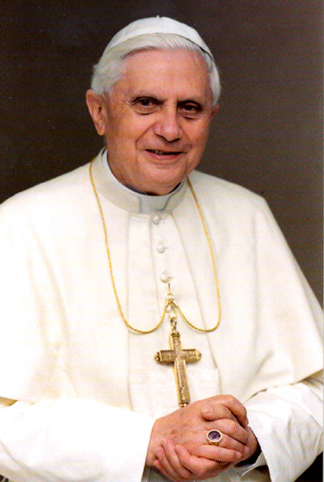
The Pontiff set out to reflect on the figure of St. Joseph, whose feast day the Church celebrates Thursday. St.Joseph is the patron saint of the Pope, who was born Joseph Ratzinger, and the patron of the universal Church.
Addressing those present, the Holy Father said a “meditation on the human and spiritual journey of Saint Joseph invites us to ponder his vocation in all its richness, and to see him as a constant model for all those who have devoted their lives to Christ in the priesthood, in the consecrated life or in the different forms of lay engagement.
St. Joseph, he said, “is not the biological father of Jesus, whose Father is God alone, and yet he lives his fatherhood fully and completely.”
“To be a father means above all to be at the service of life and growth,” Benedict XVI added. “St. Joseph, in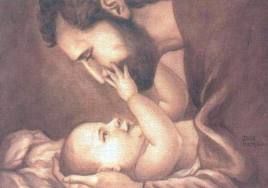 this sense, gave proof of great devotion. For the sake of Christ he experienced persecution, exile and the poverty which this entails. He had to settle far from his native town. His only reward was to be with Christ.”
He continued: “When Mary received the visit of the angel at the Annunciation, she was already betrothed to Joseph. In addressing Mary personally, the Lord already closely associates Joseph to the mystery of the Incarnation.
“Joseph agreed to be part of the great events which God was beginning to bring about in the womb of his spouse. He took Mary into his home. He welcomed the mystery that was in Mary and the mystery that was Mary herself. He loved her with great respect, which is the mark of all authentic love.”
Non-possessive love
“Joseph teaches us that it is possible to love without possessing,” said the Holy Father. “In contemplating 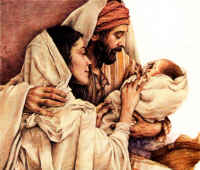 Joseph, all men and women can, by God’s grace, come to experience healing from their emotional wounds, if only they embrace the plan that God has begun to bring about in those close to him, just as Joseph entered into the work of redemption through Mary and as a result of what God had already done in her.”
“Joseph was caught up at every moment by the mystery of the Incarnation,” reflected Benedict XVI. “Not only physically, but in his heart as well, Joseph reveals to us the secret of a humanity which dwells in the presence of mystery and is open to that mystery at every moment of everyday life.
“In Joseph, faith is not separated from action. His faith had a decisive effect on his actions. Paradoxically, it was by acting, by carrying out his responsibilities, that he stepped aside and left God free to act, placing no obstacles in his way. Joseph is a ‘just man because his existence is ‘ad-justed’ to the word of God.”
“The life of Saint Joseph, lived in obedience to God’s word, is an eloquent sign for all the disciples of Jesus who seek the unity of the Church,” the Pope concluded. “His example helps us to understand that it is only by complete submission to the will of God that we become effective workers in the service of his plan to gather together all mankind into one family, one assembly, one ‘ecclesia.'”
Tags: catholic, catholic podcast, catholic prayer
This entry was posted on Wednesday, March 19th, 2014 at 4:16 am
You can follow any responses to this entry through the RSS 2.0 feed.
“Joseph did as the angel of the Lord commanded him“
[powerpress]
an excerpt from today’s reflection by Don Schwager:
Are you prepared to obey the Lord in everything? Faith in God’s word and obedience to his commands go hand in hand. Joseph, like Mary, is a model of faith and justice. Matthew tells us that Joseph was a “just manâ€. John Chrysostom, the great 5th century father writes:“The concept of ‘just’ here signifies the man who possesses all the virtues. By ‘justice’ one at times understands only one virtue in particular, as in the phrase: the one who is not avaricious (greedy) is just. But ‘justice’ also refers to virtue in general. And it is in this sense, above all, that scripture uses the word ‘justice’. For example, it refers to: ‘a just man and true’ (cf. Job 1:1), or the two were just (cf. Luke 1:6). Joseph, then, being just, that is to say good and charitable…â€
Joseph’s faith was put to the test when he discovered that his espoused wife Mary was pregnant. Joseph, being a just and God-fearing man, did not wish to embarrass, punish, or expose Mary to harm. To all outward appearances she had broken their solemn pledge to be faithful and chaste to one another. Joseph, no doubt took this troubling matter to God in prayer. He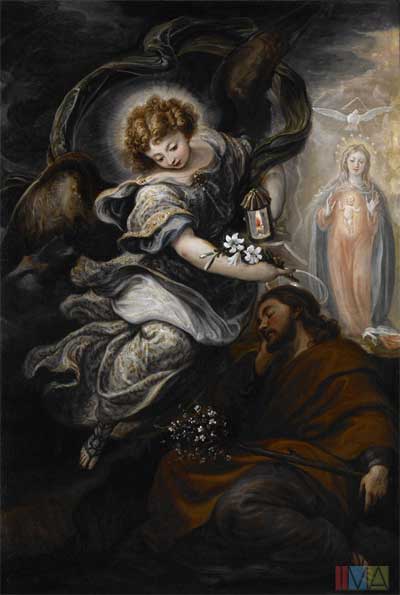 was not hasty to judge or to react with hurt and anger. God rewarded him not only with guidance and consolation, but with the divine assurance that he had indeed called Joseph to be the husband of Mary and to assume a mission that would require the utmost faith, confidence, and trust in Almighty God. Joseph believed in the divine message to take Mary as his wife and to accept the child in her womb as the promised Messiah, who is both the only begotten Son of God and son of Mary conceived by the Holy Spirit.
Joseph was a worthy successor to the great patriarchs of the old covenant – Abraham, Isaac, and Jacob. Joseph followed the call of God through the mysterious circumstances that surrounded the coming of Jesus, the long-awaited Messiah who fulfilled all the promises made to Abraham and his offspring. God entrusted this silent, humble man with the unique privilege of raising, protecting, teaching, and training Jesus as a growing child. Joseph accepted his role of fatherly care with faith, trust, and obedience to the will of God. He is a model for all who are entrusted with the care, instruction, and protection of the young. Joseph is a faithful witness and servant of God’s unfolding plan of redemption. Are you ready to put your trust in the Lord to give you his help and guidance in fulfilling your responsibilities? God gives strength and guidance to those who seek his help, especially when we face trials, doubts, fears, perplexing circumstances, and what seems like insurmountable problems and challenges in our personal lives. God our heavenly Father has not left us alone, but has given us his only begotten Son Jesus as our savior, teacher, lord, and healer. Where do you need God’s help and guidance? Ask the Lord to increase your faith and trust in his promises and in his guiding hand in your life.
“Lord Jesus, you came to free us from the power of sin, fear, death, and Satan, and to heal and restore us to wholeness of life. May I always trust in your saving help, guidance, wisdom, and plan for my life”.
for the full reflection visit : Daily Reading and Meditation
Tags: catholic, catholic podcast, catholic prayer
This entry was posted on Wednesday, March 19th, 2014 at 12:02 am
You can follow any responses to this entry through the RSS 2.0 feed.
“Whoever humbles himself will be exalted”
[powerpress]
an excerpt from today’s reflection by Don Schwager:
Respect for God and his ways inclines us to Godly humility and simplicity of heart. What is true humility and why should we embrace it? True humility is not feeling bad about yourself, or having a low opinion of yourself, or thinking of yourself as inferior to others. True humility frees us from preoccupation with ourselves, whereas a low self-opinion tends to focus our attention on ourselves. Humility is truth in self-understanding and truth in action. Viewing ourselves truthfully, with sober judgment, means seeing ourselves the way God sees us (Psalm 139:1-4). A humble person makes a realistic assessment of oneself without illusion or pretense to be something one is not. A truly humble person regards oneself neither smaller nor larger than one truly is. True humility frees us to be ourselves as God sees us and to avoid despair and pride. A humble person does not want to wear a mask or put on a facade in order to look good to others. Such a person is not swayed by accidentals, such as fame, reputation, success, or failure. Do you know the joy of Christ-like humility and simplicity of heart?
Humility is the queen or foundation of all the other virtues because it enables us to see and judge correctly, the way God sees. Humility helps us to be teachable so we can acquire true knowledge, wisdom, and an honest view of reality. It directs our energy, zeal, and ambition to give ourselves to something greater than ourselves. Humility frees us to love and serve others selflessly, for their sake, rather than our own. Paul the Apostle gives us the greatest example and model of humility in the person of Jesus Christ, who emptied himself, taking the form of a servant, and …who humbled himself and became obedient unto death, even death on a cross (Philippians 2:7-8). Do you want to be a servant as Jesus served and loved others? The Lord gives grace to those who humbly seek him.
“Lord Jesus, you became a servant for my sake to set me free from the tyranny of selfish pride and self-concern. Teach me to be humble as you are humble and to love others generously with selfless service and kindness.”
for the full reflection visit : Daily Reading and Meditation
Tags: catholic, catholic podcast, catholic prayer
This entry was posted on Tuesday, March 18th, 2014 at 12:03 am
You can follow any responses to this entry through the RSS 2.0 feed.
The Discernment of Spirits with Fr. Timothy Gallagher – Serves as an introduction to the Spiritual Exercises of St. Igantius of Loyola
[powerpress]
Episode 16 – The Fourteenth Rule: 
Likewise, he behaves as a chief bent on conquering and robbing what he desires: for, as a captain and chief of the army, pitching his camp, and looking at the forces or defenses of a stronghold, attacks it on the weakest side, in like manner the enemy of human nature, roaming about, looks in turn at all our virtues, theological, cardinal and moral; and where he finds us weakest and most in need for our eternal salvation, there he attacks us and aims at taking us.
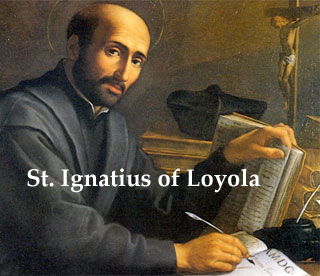 The Discernment of Spirits: Setting the Captives Free – Serves as an introduction to the Spiritual Exercises of St. Ignatius of Loyola
The 14 Rules for Discerning Spirits –
“The Different Movements Which Are Caused In The Soul”
as outlined by St. Ignatius of Loyola can be found here
Father Timothy M. Gallagher, O.M.V., was ordained in 1979 as a member of the Oblates of the Virgin Mary, a religious community dedicated to retreats and spiritual formation according to the Spiritual Exercises of St. Ignatius. Â Fr. Gallagher is featured on the EWTN series “Living the Discerning Life: Â The Spiritual Teachings of St. Ignatius of Loyola”.Â
For more information on how to obtain copies of Fr. Gallaghers’s various books and audio which are available for purchase, please visit  his  website: www.frtimothygallagher.org
 For the other episodes in this series visit
Fr. Timothy Gallagher’s “Discerning Hearts†page
Tags: discernment of spirits, Timothy Gallagher
This entry was posted on Monday, March 17th, 2014 at 10:55 am
You can follow any responses to this entry through the RSS 2.0 feed.
With Fr. Gary Caster, we discuss  “Joseph – The Man Who Raised Jesus”.  Thanks to his mother’s encouragement, Fr. Gary received a rich 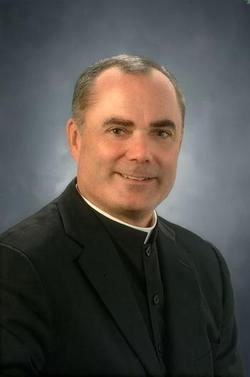 devotion to the “silent” man who witnessed to the faith in an extraordinary way.    He shares personal stories, passages from Scripture and teachings from the Catechism of the Catholic Church to demonstrate what a  model of virtue and  a protector of the Church and family, St. Joseph is in our lives today.  Another wonderful work by Fr. Gary Caster.  Good St. Joseph, pray for us!
[powerpress]
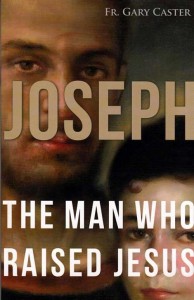 You can find the book here
From the book description:
Who was St. Joseph? Was he just a passive, incidental figure in the drama of salvation? On the contrary, in every way that Jesus needed a father, St. Joseph was that for him. And how overwhelming it must have been for Joseph to be asked to stand in the Father s place! No man has ever been asked to do so in such an unthinkable way. Every priest, and certainly every man who is a father (biologically or otherwise), should take this to heart.
Caster s book will provide a unique, in-depth presentation of Joseph from the perspective of the evangelical counsels and the theological and cardinal virtues. Each section will begin with an explanation of what each counsel or virtue means and then show how Joseph models it for us.
The descriptions of St. Joseph s life and character found in this book, while rooted in the Scripture passages that mention him, are chiefly inspired by Jesus, who spent the majority of his life at home with Joseph and Mary. For years, the three of them lived, prayed, celebrated, studied, and shared, all the while uniting their lives more intimately with God s own. Those years in Nazareth were a real preparation for the foundation upon which Jesus would build his saving ministry. And as much as Joseph and Mary offered Jesus, he offered them an ever-expanding awareness of the God that had changed both their lives. The reciprocity of love that perfectly defines the home in Nazareth is the very pattern for all family life—and therefore of the Church itself.
Tags: catholic, catholic podcast, catholic prayer
This entry was posted on Monday, March 17th, 2014 at 10:51 am
You can follow any responses to this entry through the RSS 2.0 feed.
Episode 36- Regnum Novum: Bringing forth the New Evangelization through Catholic Social Teaching with Omar Gutierrez –  We continue the study of the “Compendium of the Social Doctrine of the Church” Â Chapter 9 “The International Community”
[powerpress]
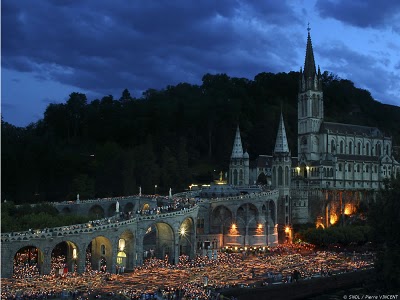
CHAPTER NINE
THE INTERNATIONAL COMMUNITY
I. BIBLICAL ASPECTS
a. Unity of the human family
b. Jesus Christ, prototype and foundation of the new humanity
c. The universal vocation of Christianity
II. THE FUNDAMENTAL RULES OF THE INTERNATIONAL COMMUNITY
a. The international community and values b. Relations based on harmony between the juridical and moral orders
III. THE ORGANIZATION OF THE INTERNATIONAL COMMUNITY
a. The value of international organizations
b. The juridical personality of the Holy See
IV. INTERNATIONAL COOPERATION FOR DEVELOPMENT
a. Cooperation to guarantee the right to development
b. The fight against poverty
c. Foreign debt
We live at a very special time. The confluence of many things has brought forth the clear need to be able to articulate the Social Teaching of the Catholic Church in a way that is accessible and applicable. This is not to be an effort where high-minded theories are to be bandied about. Rather, this is a time of opportunity wherein we can apply the Social Doctrine to the concrete so as to bring about a New Kingdom, a Revolution. – Omar G.
Also visit Omar’s “Discerning Hearts” page Catholic Social Teaching 101
You can find Omar Gutierrez’s book here
In The Urging of Christ’s Love Omar Gutiérrez tells the stories of eleven people who lived their lives in pursuit of Christ Jesus. Each Saint, Blessed or Servant of God is considered in the context of Catholic Social Teaching. Then at the end of each chapter a prayer is offered and quotes from the Compendium of the Social Doctrine of the Church are provided in order to link the lessons we can learn from the saint’s life to Church teaching. By discovering some new saint friends, and rediscovering some old ones, The Urging of Christ’s Love presents Catholic Social Teaching in an accessible and important way.
Tags: catholic, catholic podcast, catholic prayer
This entry was posted on Monday, March 17th, 2014 at 10:01 am
You can follow any responses to this entry through the RSS 2.0 feed.
“Forgive, and you will be forgiven“
[powerpress]
an excerpt from today’s reflection by Don Schwager: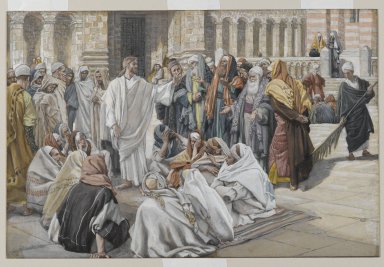
What makes true disciples of Jesus Christ different from those who do not know the Lord Jesus and what makes Christianity distinct from any other religion? It is grace – treating others not as they deserve, but as God wishes them to be treated – with loving-kindness, forebearance, and mercy. God shows his goodness to the unjust as well as to the just. His love embraces saint and sinner alike. God always seeks what is best for each one of us and he teaches us to seek the greatest good of others, even those who hate and abuse us. Our love for others, even those who are ungrateful and unkind towards us, must be marked by the same kindness and mercy which God has shown to us. It is easier to show kindness and mercy when we can expect to benefit from doing so. How much harder when we can expect nothing in return. Our prayer for those who do us ill both breaks the power of revenge and releases the power of love to do good in the face of evil.
How can we possibly love those who cause us grief, ill-will, and harm? With God all things are possible. He gives power and grace to those who trust in his love and who seek his help and wisdom. The Lord is ready to work in and through us by his Holy Spirit, both to purify our minds and hearts and to guide us in choosing what is good and loving. Paul the Apostle reminds us that “God’s love has been poured into our hearts through the Holy Spirit which has been given to us” (Romans 5:5) God’s love conquers all, even our hurts, injuries, fears, and prejudices. Only the cross of Jesus Christ and his victory over sin can free us from the tyranny of malice, hatred, revenge, and resentment, and give us the courage to overcome evil with good (Romans 12:21). Such love and grace has power to heal, restore, and transform us into the image of Christ. Do you know the power of Christ’s redeeming love and mercy?
“Lord Jesus, your love brings freedom, pardon, and joy. Transform my heart with your love that nothing may make me lose my temper, ruffle my peace, take away my joy, or make me bitter towards anyone.”
for the full reflection visit : Daily Reading and Meditation
Tags: catholic, catholic podcast, catholic prayer
This entry was posted on Monday, March 17th, 2014 at 12:44 am
You can follow any responses to this entry through the RSS 2.0 feed.
Episode 3 – The Cross of Christ teaches us… – Second Week
[powerpress]
In “The Power of the Cross”, Michael Dubruiel penned a truly exceptional meditation on the Cross of Christ which  serves beautifully as a source for reflection any time of the year, but it is particularly poignant and compelling during the weeks of Lent. Several years ago Bruce and I had the chance to have a series of conversations with Michael during Lent using his book for reflection…it was a big hit with the audience. Those discussions have been remastered and made available once again here. Michael died unexpectedly in of February 2009, but his gifts continue to be shared through his books and many other venues, and hopefully through this humble portal. The sentiments and teachings Michael offers is truly timeless.
Episode 3 – The Cross of Christ unites… – Michael discusses:
Day 8 – The Temporal and Eternal
Day 9 – Those Divided by Sin
Day 10 – In Humility
Day 11 – In Sin
Day 12 – Those Who Suffer For Justice
Day 13 – Us in the Work We Have to Do
Day 14 – God’s Mercy and Love
Michael’s wife, author Amy Welborn, has made “The Power of the Cross” available as a free e-book available over the internet ! Â I HIGHLY encourage you to download this exceptional work…there also plans to make it once again available as a paperback book.
 The Power of the Cross is now available as a free e-book,
check out more information by going here
Check out more at the Discerning Hearts’ Michael Dubruiel page
Tags: michael dubruiel, The Power of the Cross
This entry was posted on Monday, March 17th, 2014 at 12:26 am
You can follow any responses to this entry through the RSS 2.0 feed.
“This is my beloved Son; listen to him”
[powerpress]
an excerpt from today’s reflection by Don Schwager:
What is the significance of this mysterious appearance? Jesus went to the mountain knowing full well what awaited him in Jerusalem – his betrayal, rejection and crucifixion. Jesus very likely discussed this momentous decision to go to the cross with Moses and Elijah. God the Father also spoke with Jesus and gave his approval: This is my beloved Son; listen to him. The Father glorified his son because he obeyed. The cloud which overshadowed Jesus and his apostles fulfilled the dream of the Jews that when the Messiah came the cloud of God’s presence would fill the temple again (see Exodus 16:10, 19:9, 33:9; 1 Kings 8:10; 2 Maccabees 2:8).
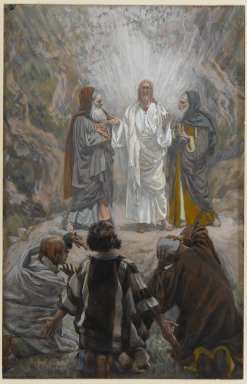 The Lord Jesus not only wants us to see his glory – he wants to share this glory with us. And Jesus shows us the way to the Father’s glory – follow me – obey my words – take the path I have chosen for you and you will receive the blessings of my Father’s kingdom – your name will be written in heaven. Jesus succeeded in his mission because he went to Calvary so that Paradise would be restored to us once again. He embraced the cross to obtain the crown of glory that awaits each of us, if we will follow in his footsteps.
Luke’s gospel tells us that while Jesus was transfigured, Peter, James, and John were asleep (Luke 9:32)! Upon awakening they discovered Jesus in glory along with Moses and Elijah. How much do we miss of God’s glory and action because we are asleep spiritually? There are many things which can keep our minds asleep to the things of God: Mental lethargy and the “unexamined life” can keep us from thinking things through and facing our doubts and questions. The life of ease can also hinder us from considering the challenging or disturbing demands of Christ. Prejudice can make us blind to something new the Lord may have for us. Even sorrow can be a block until we can see past it to the glory of God. Are you spiritually awake? Peter, James, and John were privileged witnesses of the glory of Christ. We, too, as disciples of Christ are called to be witnesses of his glory. We all, with unveiled face, beholding the glory of the Lord, are being changed into his likeness from one degree of glory to another; for this comes from the Lord who is the Spirit (2 Corinthians 3:18). The Lord wants to reveal his glory to us, his beloved disciples. Do you seek his presence with faith and reverence?
“Lord Jesus, keep me always alert and awake to you, to your word, your action, and your daily presence in my life. Let me see your glory.â€
for the full reflection visit : Daily Reading and Meditation
Tags: God the Father, Jesus, Lord Jesus
This entry was posted on Sunday, March 16th, 2014 at 12:23 am
You can follow any responses to this entry through the RSS 2.0 feed.
“Love and pray for your enemies“
[powerpress]
an excerpt from today’s reflection by Don Schwager: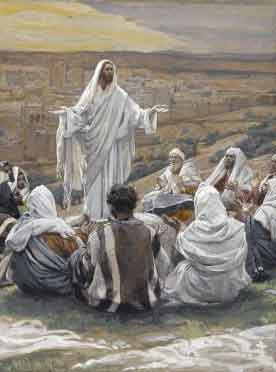
Do you know the love that conquers every fear, sin, and selfish desire? God renews his love for us each and every day. His love has the power to free us from every form of evil – selfishness, greed, anger, hatred, jealously and envy. What’s the distinctive feature of Jesus’ life and the life of those transformed by his redeeming love? It’s grace – treating others, not as they deserve, but as God wishes them to be treated – with loving-kindness and mercy. Jesus is God’s grace incarnate. His love is unconditional and is wholly directed towards our good. God is good to all, the just and the unjust. His love embraces saint and sinner alike. That’s why Jesus willingly went to the cross for our sake, to free us from the power of sin, ignorance, and prejudice. God’s grace sets us free from everything that would keep us from him and his love. How can we possibly love as God loves and overcome evil with good? With God all things are possible. He gives grace in abundance through the gift of the Holy Spirit, who converts our hearts and minds and teaches us how to live according to God’s truth and love.
Was Jesus exaggerating when he said we must be perfect as our heavenly Father is perfect? The original meaning of “perfect” in Aramaic is “completeness” or “wholeness” – not lacking in what is essential. God gives us every good gift in Jesus Christ so that we may not lack anything we need to carry out his will and to live as his sons and daughters. He knows our frailty and sinfulness better than we do. And he assures us of his grace and help to follow in his ways. In the cross of Jesus we see the way of perfect love. Do you want to grow in the knowledge, wisdom, and love of God? Ask the Holy Spirit to set your heart on fire with the love of God.
“Give  us, Lord, a humble, quiet, peaceable, patient, tender and charitable mind, and in all our thoughts, words and deeds a taste of the Holy Spirit. Give us, Lord, a lively faith, a firm hope, a fervent charity, and love of you. Take from us all lukewarmness in meditation, dullness in prayer. Give us fervor and delight in thinking of you and your grace, your tender compassion towards me. The things we pray for, good Lord, give us grace to labor for: through Jesus Christ our Lord. “ (Prayer of Thomas More)
for the full reflection visit : Daily Reading and Meditation
Tags: catholic, catholic podcast, catholic prayer
This entry was posted on Saturday, March 15th, 2014 at 6:17 am
You can follow any responses to this entry through the RSS 2.0 feed.
Episode 21 – The Holy Rule of St. Benedict: A Spiritual Path for Today’s World with Fr. Mauritius Wilde O.S.B., PhD.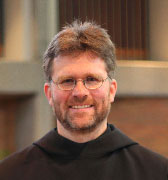
Fighting the Demons
[powerpress]
From the Holy Rule of St. Benedict:
CHAPTER I
an excerpt:
The second kind is that of Anchorites, or Hermits, that is, of those who, no longer in the first fervor of their conversion, but taught by long monastic practice and the help of many brethren, have already learned to fight against the devil; and going forth from the rank of their brethren well trained for single combat in the desert, they are able, with the help of God, to cope single-handed without the help of others, against the vices of the flesh and evil thoughts.
Special note: Â Fr. Mauritus speaks of a book by Evagrius of Pontus, the link is below :
Evagrius Of Pontus: Talking Back: A Monastic Handbook for Combating Demons (Cistercian Studies)
Father Mauritius Wilde, OSB, Ph.D., did his philosophical, theological and doctoral studies in Europe. He is the author of several books and directs retreats regularly. He serves as Prior of our monastery in Schuyler.
 For more information about the ministry of the the Missionary Benedictines of Christ the King Priory in Schuyler, Nebraska visit here:
Tags: Fr, Holy Rule of St. Benedict, Mauritius
This entry was posted on Friday, March 14th, 2014 at 4:13 pm
You can follow any responses to this entry through the RSS 2.0 feed.
“Do not be angry, be reconciled“
[powerpress]
an excerpt from today’s reflection by Don Schwager: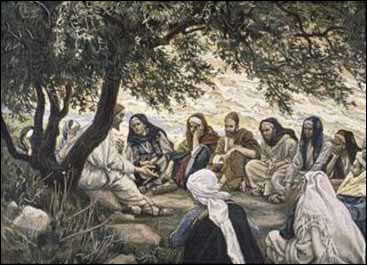
Do you allow sin or anger to master your life? The first person to hate his brother was Cain. God warned Cain: ‘Why are you angry? ..Sin in couching at the door; it’s desire is for you, but you must master it (Genesis 4:6-7). Sin doesn’t just happen; it first grows as a seed in one’s heart. Unless it is mastered, by God’s grace, it grows like a weed and chokes the life out of us. Jesus addressed the issue of keeping the commandments with his disciples. The scribes and Pharisees equated righteousness with satisfying the demands of the law. Jesus showed them how short they had come. Jesus points to the heart as the seat of desire, choice, and intention. Unless forbidden and evil desires are uprooted and cut-out, the heart will be poisoned and the body become a slave to sin and passion. Jesus illustrates his point with the example of the commandment to not kill. Murder first starts in the heart as the seed of forbidden anger that grows within until it springs into words and actions against one’s brother or neighbor. This is a selfish anger that broods and is long-lived, that nurses a grudge and keeps wrath warm, and that refuses to die. Anger in the heart as well as anger in speech or action are equally forbidden. The Lord Jesus commands by grace – take away the anger in your heart and there will be no murder.
What is the antidote for overcoming anger and rage? Mercy, forbearance, and kindness spring from a heart full of love and forgiveness. God has forgiven us and he calls us to extend mercy and forgiveness towards those who cause us grief or harm. In the cross of Jesus we see the supreme example of love and the power for overcoming evil. Only God’s love and grace can set our hearts and minds free from the tyranny of wounded pride and spiteful revenge. Do you harbor any anger towards another person? And are you quick to be reconciled when a rupture has been caused in your relationships? Ask God to set you free and to fill your heart and mind with his love and truth.
Do you seek to live peaceably and charitably with all?
“Lord Jesus, my heart is cold. Make it warm, compassionate, and forgiving towards all, even those who do me harm. May I only think and say what is pleasing to you and be of kind service to all I meet.â€
for the full reflection visit : Daily Reading and Meditation
Tags: catholic, catholic podcast, catholic prayer
This entry was posted on Friday, March 14th, 2014 at 12:03 am
You can follow any responses to this entry through the RSS 2.0 feed.
“How much more will your Father who is in heaven give good things to those who ask him!”
[powerpress]
an excerpt from today’s reflection by Don Schwager: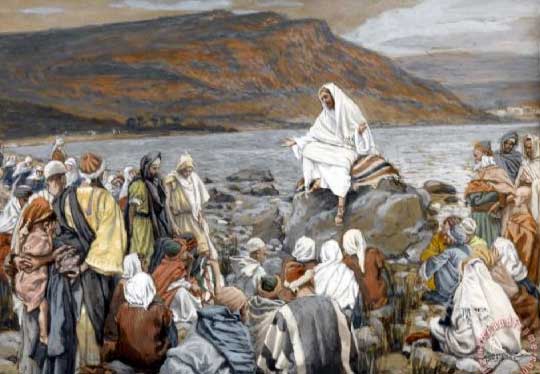
Those who know and trust in God’s love, pray with great boldness. Listen to what John Chrysostom, a 5th century church father, has to say about the power of prayer: “Prayer is an all-efficient panoply [i.e. ‘a full suit of armor’ or ‘splendid array’], a treasure undiminished, a mine never exhausted, a sky unobstructed by clouds, a haven unruffled by storm. It is the root, the fountain, and the mother of a thousand blessings. It exceeds a monarch’s power. ..I speak not of the prayer which is cold and feeble and devoid of zeal. I speak of that which proceeds from a mind outstretched, the child of a contrite spirit, the offspring of a soul converted – this is the prayer which mounts to heaven. ..The power of prayer has subdued the strength of fire, bridled the rage of lions, silenced anarchy, extinguished wars, appeased the elements, expelled demons, burst the chains of death, enlarged the gates of heaven, relieved diseases, averted frauds, rescued cities from destruction, stayed the sun in its course, and arrested the progress of the thunderbolt. In sum prayer has power to destroy whatever is at enmity with the good.â€
Prayer flows from the love of God; and the personal love we show to our neighbor is fueled by the love that God has poured into our hearts through the Holy Spirit (Romans 5:5). Jesus concludes his discourse on prayer with the reminder that we must treat our neighbor in the same way we wish to be treated by God and by others. We must not just avoid doing harm to our neighbor, we must actively seek his or her welfare. In doing so, we fulfill the law and the prophets, namely what God requires of us – loving God with all that we have and are and loving our neighbor as ourselves. The Holy Spirit is every ready to transform our lives in Jesus’ way of love. Do you thirst for holiness and for the fire of God’s love?
“Let me love you, my Lord and my God, and see myself as I really am – a pilgrim in this world, a Christian called to respect and love all whose lives I touch, those in authority over me or those under my authority, my friends and my enemies. Help me to conquer anger with gentleness, greed by generosity, apathy by fervor. Help me to forget myself and reach out towards others.” (Prayer attributed to Clement XI of Rome)
for the full reflection visit : Daily Reading and Meditation
Tags: catholic, catholic podcast, catholic prayer
This entry was posted on Thursday, March 13th, 2014 at 12:18 am
You can follow any responses to this entry through the RSS 2.0 feed.
USCCA12- Episode 12-Â Â Mary: Â The Church’s First and Most Perfect Member
[powerpress]
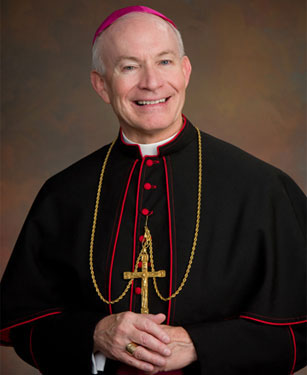
Archbishop Lucas offers insights on the US Catholic Catechism for Adults Chapter 12:
The Second Vatican Council remains us that Mary is a member of the Church who “occupies a place in the Church which is the highest after Christ and also closest to us” (LG, no. 54).  She is the first and the greatest of all the disciples of Christ.
The Most Reverend George J. Lucas leads the Archdiocese of Omaha.Â
For other episodes in the visit our Archbishop George Lucas page
This programs is based on:
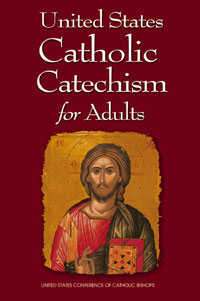
More information can be found here.
We wish to thank the USCCB for the permissions granted for use of  relevant material used in this series.
Also we wish to thank Fr. Ryan Lewis   for his vocal talents in this episode.
Tags: Archbishop Lucas, Catholic Catechism, George Lucas
This entry was posted on Wednesday, March 12th, 2014 at 12:58 pm
You can follow any responses to this entry through the RSS 2.0 feed.
Episode 8 -The Way of Mystery: The Eucharist and Moral Living 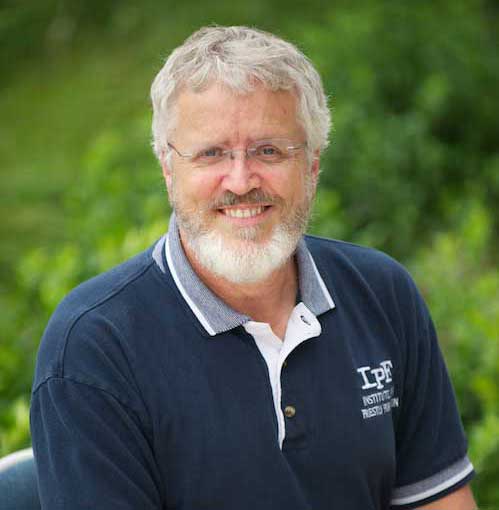
The actual role of the reader (not performer), the role of the deacon, the role of those who hear the Word
[powerpress]
For more episodes in “The Way of Mystery” Series click here
Deacon James Keating, PhD, the director of Theological Formation for the Institute for Priestly Formation, located at Creighton University, in Omaha, is making available to â€Discerning Hearts†and all who listen, his series of programs entitled “The Way of Mysteryâ€.
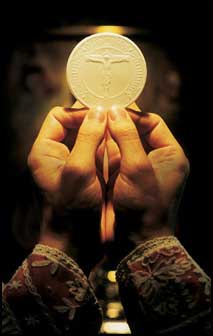 The Vatican II documents remind us that the spiritual journey is not made in a vacuum, that God has chosen to save us, not individually, but as The People of God. The Eucharist must help Christians to make their choices by discerning out of Christ’s paschal mystery. For this process to take place, however, Christians must first understand how the Eucharist puts them in touch with Christ’s passion, death, and resurrection, and what concrete implications being in touch with this mystery has for their daily lives.

For more information on the “Institute of Priestly Formation†and for other material available by Deacon Keating, just click here
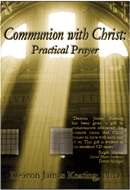
Don’t forget to pickup a copy of “Communion with Christ†, it is one of the best audio sets on prayer…ever!
Check out Deacon Keating’s “Discerning Heart†page
Tags: institute for priestly formation, james keating, the eucharist, theological formation
This entry was posted on Tuesday, March 11th, 2014 at 8:24 pm
You can follow any responses to this entry through the RSS 2.0 feed.