 Site Type
 Featured
 Fonts
Fonts Skins
Skins
Dr. Matthew Bunson discusses the life, times and work of  St. Athanasius of Alexandria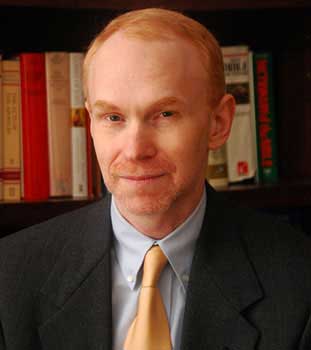
[powerpress]
For more on St. Athanasius of Alexandria and his teachings
AthanasiusÂ
-Â On the Incarnation of the Word
-Â Deposition of Arius
-Â Statement of Faith
-Â On Luke 10:22 (Matthew 11:27)
-Â Circular Letter
-Â Apologia Contra Arianos
-Â De Decretis
-Â De Sententia Dionysii
-Â Vita S. Antoni (Life of St. Anthony)
-Â Ad Episcopus Aegypti et Libyae
-Â Apologia ad Constantium
-Â Apologia de Fuga
-Â Historia Arianorum
-Â Four Discourses Against the Arians
-Â De Synodis
-Â Tomus ad Antiochenos
-Â Ad Afros Epistola Synodica
-Â Historia Acephala
-Â Letters
Athanasius was undoubtedly one of the most important and revered early Church Fathers. But this great Saint was above all the impassioned theologian of the Incarnation of the Logos, the Word of God who – as the Prologue of the fourth Gospel says – “became flesh and dwelt among us” (Jn 1: 14).
For this very reason Athanasius was also the most important and tenacious adversary of the Arian heresy, which at that time threatened faith in Christ, reduced to a creature “halfway” between God and man, according to a recurring tendency in history which we also see manifested today in various forms.
In all likelihood Athanasius was born in Alexandria, Egypt, in about the year 300 A.D. He received a good education before becoming a deacon and secretary to the Bishop of Alexandria, the great Egyptian metropolis. As a close collaborator of his Bishop, the young cleric took part with him in the Council of Nicaea, the first Ecumenical Council, convoked by the Emperor Constantine in May 325 A.D. to ensure Church unity. The Nicene Fathers were thus able to address various issues and primarily the serious problem that had arisen a few years earlier from the preaching of the Alexandrian priest, Arius.
With his theory, Arius threatened authentic faith in Christ, declaring that the Logos was not a true God but a created God, a creature “halfway” between God and man who hence remained for ever inaccessible to us. The Bishops gathered in Nicaea responded by developing and establishing the “Symbol of faith” [“Creed”] which, completed later at the First Council of Constantinople, has endured in the traditions of various Christian denominations and in the liturgy as the Niceno-Constantinopolitan Creed.
In this fundamental text – which expresses the faith of the undivided Church and which we also recite today, every Sunday, in the Eucharistic celebration – the Greek term homooúsiosis featured, in Latin consubstantialis: it means that the Son, the Logos, is “of the same substance” as the Father, he is God of God, he is his substance. Thus, the full divinity of the Son, which was denied by the Arians, was brought into the limelight.
For more visit Vatican.va
Dr. Matthew Bunson, Senior Fellow of the St. Paul Center for Biblical Theology, is one of the United States’ leading authorities on the papacy and the Church.
His books include: The Encyclopedia of Catholic History; The Encyclopedia of Saints; Papal Wisdom; All Shall Be Well; Encyclopedia of the Roman Empire; and The Angelic Doctor: The Life and World of St. Thomas Aquinas; The Pope Encyclopedia; We Have a Pope! Benedict XVI, the first Catholic biography of the Holy Father in the English language; the Encyclopedia of U.S. Catholic History; Pope Francis. Â His also the editor of OSV’s “The Catholic Answer” magazine.
Tags: Church, church fathers, faith, matthew bunson, work
This entry was posted on Friday, September 6th, 2013 at 11:15 am
You can follow any responses to this entry through the RSS 2.0 feed.
Join Teresa Monaghen, of Pro Sanctity, as she offers a “Personal Plan for Holiness”. Listen along with these short, but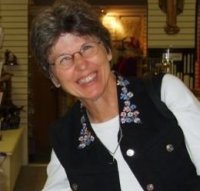 beautiful meditations which encourage us to continue on our journey as “saints in the making”!
[powerpress]
Learn more about Pro Sanctity at www.prosanctity.org
Tags: Join Teresa Monaghen, meditations, personal plan for holiness, pro sanctity, saints, teresa monaghen
This entry was posted on Friday, September 6th, 2013 at 12:08 am
You can follow any responses to this entry through the RSS 2.0 feed.
Episode 4 -The Second Rule: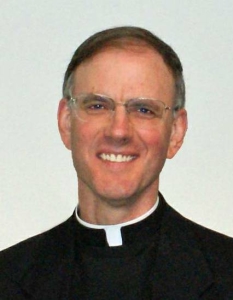
In the persons who are going on intensely cleansing their sins and rising from good to better in the service of God our Lord, it is the method contrary to that in the first Rule, for then it is the way of the evil spirit to bite, sadden and put obstacles, disquieting with false reasons, that one may not go on; and it is proper to the good to give courage and strength, consolations, tears, inspirations and quiet, easing, and putting away all obstacles, that one may go on in well doing.
.[powerpress]
The Discernment of  Spirits: Setting the Captives Free – Serves as an introduction to the coming series and the Spiritual Exercises of St. Igantius of Loyola
Father Timothy M. Gallagher, O.M.V., was ordained in 1979 as a member of the Oblates of the Virgin Mary, a religious community dedicated to retreats and spiritual formation according to the Spiritual Exercises of St. Ignatius. Â Fr. Gallagher is featured on the EWTN series “Living the Discerning Life: Â The Spiritual Teachings of St. Ignatius of Loyola”.
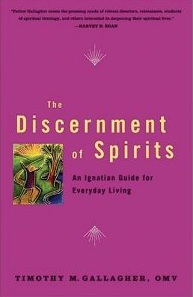 “The Discernment of Spirits: Setting the Captives Free” series is based on Fr. Gallagher’s book “Discern
 ment of Spirits” published by Crossroads Books.
.
For more information on the work of Fr. Timothy Gallagher check out his website
.
For the other episodes in this series check out Fr. Timothy Gallagher’s “Discerning Hearts†page
Tags: evil, ewtn, spiritual formation, work
This entry was posted on Thursday, September 5th, 2013 at 8:34 am
You can follow any responses to this entry through the RSS 2.0 feed.
 FG#8- Interior Freedom episode 8 – Fountains of Grace: reflections on contemporary spiritual classics with Donna Garrett
Join host Donna Garrett, with Fr. Daniel Brandenburg, LC, as they discuss the spiritual classic “Interior Freedom” by Fr.  Jacques Philippe  a priest of  Communaute des Beatitudes, an international association of the faithful of Pontifical Right founded in France in 1973.  The members of the Community, which has a contemplative vocation based on Carmelite spirituality, are actively engaged in the service of the poor and the proclamation of the Gospel.
[powerpress]
Discussed in this episode, among other topics, Â from “Interior Freedom” page 112
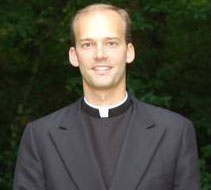
Donna Garrett is joined in this particular series by Fr. Daniel Brandenburg, LC
“Instead of following the impulses of the Spirit, people give themselves up, under a pretext of freedom, to their passions to selfishness and sin and sin in all its forms: immorality, impurity, licentiousness, idolatry, sorcery, enmity, strife, jealousy, anger, selfishness, dissension, party spirit, envy, drunkenness carousing and the like. St Paul reminds us of a classic teaching worth repeating in these confused times; licentiousness is not freedom. It s slavery in which people are trapped by what is most superficial in humanity selfish desires, fears weaknesses and so on. We must wage an unceasing fight against the tendencies described by St Paul and must remain permanently open to the healing graces that come from the Cross of Christ. Then we become truly capable of accomplishing good.”
For other episodes in the this series click here “Fountains of Grace w/Donna Garrett”
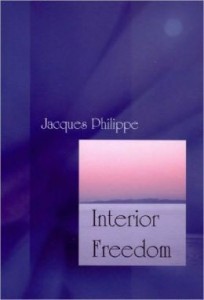
You can find “Interior Freedom” here
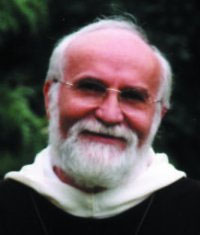
Fr. Jacques Philippe
Tags: Donna Garrett, freedom, Interior Freedom, reflections
This entry was posted on Thursday, September 5th, 2013 at 6:42 am
You can follow any responses to this entry through the RSS 2.0 feed.
There is an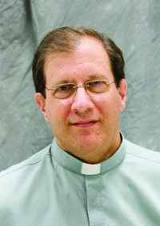 endless collection of reflections on the life, teachings, and work of Blessed Mother Teresa of Calcutta…all wonderful and worth exploration. One however stands out for me, and that is the writings of Fr. Joseph Langford, co-founder with Mother Teresa of the Missionaries of Charity Fathers. In particular, “Mother Teresa: In the Shadow of Our Lady”
[powerpress]Join Bruce and I as we talk with Fr. Langford about Mother Teresa and Our Lady
“Stay very close to Our Lady. If you do this, you can do great things for God and the good of people.” –Mother Teresa of Calcutta

As it was for Mother Teresa, so it can be for the rest of us. By standing close to Our Lady we can find the grace and courage to overcome our own personal trials and crosses. Summon the same powerful presence and aid of Our Lady by following the example of Mother Teresa. From dawn to dusk, decade to decade, Mother Teresa’s life had been spent, in every sense of the word, in the shadow of Our Lady. Our Lady helps us, as Mother Teresa found in her vision, to become contemplatives at the foot of the cross–to discover God’s presence and love, even in the midst of our trials and dark nights. Nothing was impossible for Mother Teresa while she clung to Our Lady, and as Mother Teresa tells us, “nothing is impossible for all who call Mary mother.”
“Sitting with Mother Teresa, watching her tend to the sick and the dying, feeling the aura of holiness around her person, seeing her bent in prayer, lost in God–how often I asked myself if I was not
seeing something of Our Lady, experiencing a glimpse of the Virgin of Nazareth” –-Author and co-founder of Mother Teresa’s priests’ community, Joseph Langford, MC
This is a very special book, check it out!
This entry was posted on Thursday, September 5th, 2013 at 12:14 am
You can follow any responses to this entry through the RSS 2.0 feed.
Episode 1 – Regnum Novum: Bringing forth the New Evangelization through Catholic Social Teaching with Omar Guiterrez – Introduction and Value # 1 – Jesus Christ
[powerpress]
From episode … 1.     Jesus Christ
You may not believe how many advocates of social justice are only too ready to chuck Jesus out the window in order to get you to buy their plan. One such program of which I’m familiar actually includes materials that deny the divinity of Christ, several times, and deny the salvific work of the cross. As Pope Paul VI and Pope Benedict XVI have said, the Social Doctrine is evangelization. If it is not rooted in the truth, then it can be manipulated to mean whatever one wants it to mean. The truth is quite simply, Jesus Christ who, as Gaudium et spes states, reveals man to himself. The Social Doctrine and the work of charity must stem from an intimate knowledge of Jesus Christ so that they might serve the whole person and point back to Christ.
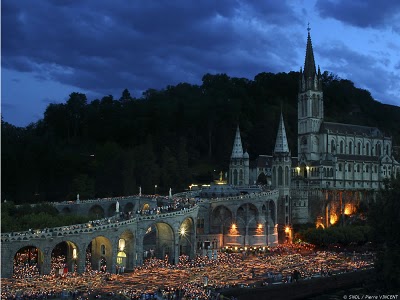
We live at a very special time. The confluence of many things has brought forth the clear need to be able to articulate the Social Teaching of the Catholic Church in a way that is accessible and applicable. This is not to be an effort where high-minded theories are to be bandied about. Rather, this is a time of opportunity wherein we can apply the Social Doctrine to the concrete so as to bring about a New Kingdom, a Revolution. – Omar G.Â
Discerning Hearts is blessed to present Omar F. A. Guiterrez, M.A. , Special Assistant  to Archbishop George Lucas of the Archdiocese of Omaha, in a groundbreaking series which breaks open the heart of Catholic Social Doctrine.
Tags: jesus christ, social doctrine, truth, work
This entry was posted on Wednesday, September 4th, 2013 at 8:17 am
You can follow any responses to this entry through the RSS 2.0 feed.
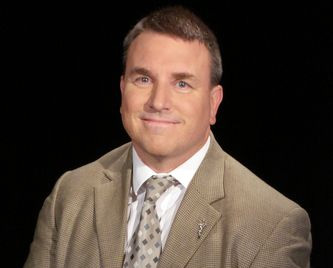 Episode 15 – Great Works in Western Literature with Joseph Pearce – St. Augustine
[powerpress]
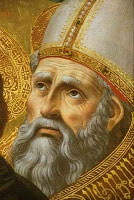 The Confessions of Saint Augustine is considered one of the greatest Christian classics of all time. It is an extended poetic, passionate, intimate prayer that Augustine wrote as an autobiography sometime after his conversion, to confess his sins and proclaim God’s goodness. Just as his first hearers were captivated by his powerful conversion story, so also have many millions been over the following sixteen centuries. His experience of God speaks to us across time with little need of transpositions.
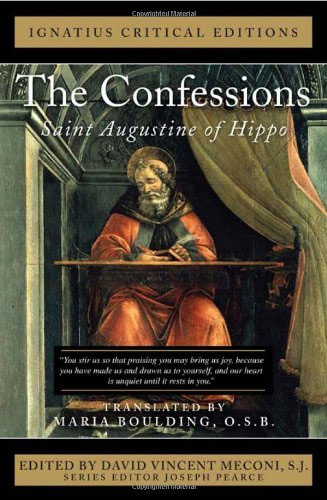 Based on the Ignatius Critical Edition, this series examines, from the Judeo-Christian perspective, the life, the times, and influence of authors of great works in literature .
Joseph Pearce is currently the Writer-in-Residence and Visiting Fellow at Thomas More College of Liberal Arts in Merrimack, New Hampshire. He is also Visiting Scholar at Mount Royal Academy in Sunapee, New Hampshire. He is also Visiting Scholar at Mount Royal Academy in Sunapee, New Hampshire. He is  co-editor of the Saint Austin Review (or StAR), an international review of Christian culture, literature, and ideas published in England (Family Publications) and the United States (Sapientia Press). He is also the author of many books, including literary biographies of Solzhenitsyn, J. R. R. Tolkien, C. S. Lewis, G. K. Chesterton, and Oscar Wilde.
To learn more about the authors and titles available in the Ignatius Critical Editions
Tags: catholic, catholic podcast, catholic prayer, cathollc spirituality, conversion, joseph pearce, New Hampshire, prayer
This entry was posted on Tuesday, September 3rd, 2013 at 8:28 am
You can follow any responses to this entry through the RSS 2.0 feed.
We talk with Mike Aquilina  about St. Gregor the Great, a father of the Church.
 [powerpress]
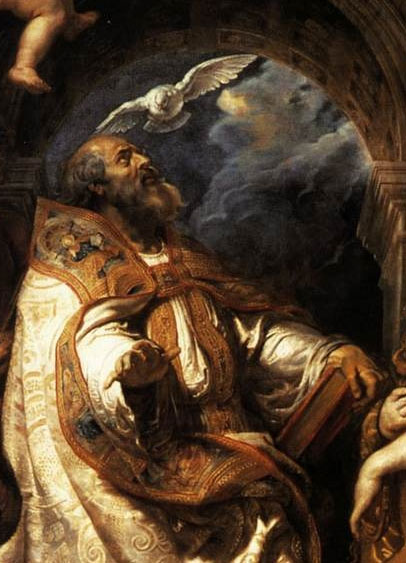 St. Gregory the Great…the tradition of the Church considers him one of the four great doctors of the Latin Church. Born in Rome, Italy, in AD 540, St. Gregory was the son of Gordianus, a wealthy senator, and Silvia, who later became a saint. (Saints make saints after all…).
His youth was a troubled one. In his writings he chronicles the perpetual seiges that Rome endured at the hands of the barbarians.  Those nasty Lombards! Pillaging, raping, massacring, they would plague the Church and the people of the land for 200 years, you name it..by any standard, they were bad!
Saint Gregory became the Prefect of Rome at the age of thirty, and the people loved him because he was able to keep them safe. A few years later, like his parents, he gave his wealth away. He became a Benedictine monk. But the pope of the time, recalled him to Rome to serve as a deacon and to help the city, which was again attacked by the Lombards.
On the third day of September in 590, after he had first been ordained a priest, Saint Gregory was consecrated Pope and Bishop of Rome, in Saint Peter’s Basilica. He was the first monk to become Pope.  The Holy Spirit didn’t waste anytime moving him to service!
Through Saint Leander and his brother, Saint Isidore of Seville, as well as the martyr 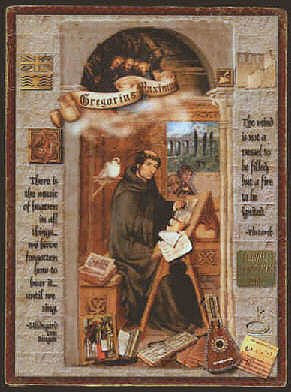 Saint Hermenegild, Saint Gregory recovered Spain from the Arians. Through Queen Theodelinda, the wife of the Lombard King Agilulf, he was able to begin the conversion of the Lombard nation and the tempering of their ferocious and cruel natures. He won France back and began conversions in England. Saint Gregory was, above all else, a vigilant guardian of the Church’s doctrine, always the mark of a holy Pope. He ordained, early in his pontificate that the first four Ecumenical Councils of the Church should be treated with the respect given to the four Gospels. He worked unceasingly to stamp out heresy. He ordered that at the beginning of Lent the blessed ashes should be placed on the foreheads of the faithful, instead of only the head of the Pope — as had been the custom up to that time — and that the priest should repeat to each one, “Remember man, that dust thou art, and unto dust thou shalt return”. excerpted in part from an article by Sister Catherine Goddard Clark, M.I.C.M.
He is known for his magnificent contributions to the Liturgy of the Mass and Office. The “Gregorian Chant” is named in honor of Saint Gregory’s patient labor in restoring the ancient chant of the Church and in setting down the rules to be followed so that Church music might more perfectly fulfill its function.
Saint Gregory the Great died on the twelfth of March, 604, at the age of sixty-four. He was canonized immediately after his death. Later, because of the volume, the extraordinary insight and the profundity of his writings, the depth and extent of his learning, and the heroic holiness of his life, the Church gratefully placed him beside Jerome and Ambrose and Augustine. Saint Gregory the Great became the fourth of the Church’s four great Doctors of the West. –
What would today be like without a little Gregorian Chant in honor of our St. Gregory?
 Spiritual Writings:
-Â Pastoral Rule
-Â Register of Letters
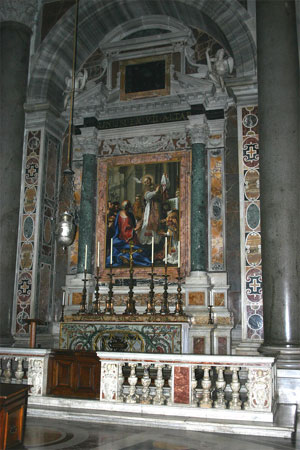 The altar of St. Gregory the Great at St. Peter’s in Rome. One of my favorite places to pray at the Vatican.Â
Tags: benedictine monk, bishop of rome, Church, ecumenical councils of the church, fathers mike, holy spirit, Latin Church, our sunday visitor, rome, saint gregory
This entry was posted on Tuesday, September 3rd, 2013 at 12:01 am
You can follow any responses to this entry through the RSS 2.0 feed.
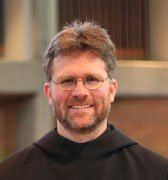 Episode 3 – The Holy Rule of St. Benedict: A Spiritual Path for Today’s World with Fr. Mauritius Wilde O.S.B., PhD.
In place of the disability to express ourselves, to sing
[powerpress]
From the Holy Rule of St. Benedict:
CHAPTER XIX
We believe that God is present everywhere and that the eyes of the Lord behold the good and the bad in every place (cf Prov 15:3). Let us firmly believe this, especially when we take part in the Work of God. Let us, therefore, always be mindful of what the Prophet saith, “Serve ye the Lord with fear” (Ps 2:11). And again, “Sing ye wisely” (Ps 46[47]:8). And, “I will sing praise to Thee in the sight of the angels” (Ps 137[138]:1). Therefore, let us consider how it becometh us to behave in the sight of God and His angels, and let us so stand to sing, that our mind may be in harmony with our voice.
Father Mauritius Wilde, OSB, Ph.D., did his philosophical, theological and doctoral studies in Europe. He is the author of several books and directs retreats regularly. He serves as Prior of our monastery in Schuyler.
 For more information about the ministry of the the Missionary Benedictines of Christ the King Priory in Schuyler, Nebraska visit here:
Tags: Holy Rule of St. Benedict, Mauritius
This entry was posted on Wednesday, August 28th, 2013 at 10:14 pm
You can follow any responses to this entry through the RSS 2.0 feed.
St. Hildegard and  “Conversatio Morum – the Conversion of Life” – The Mystery of Faith in the Wisdom of the Saints
[powerpress]
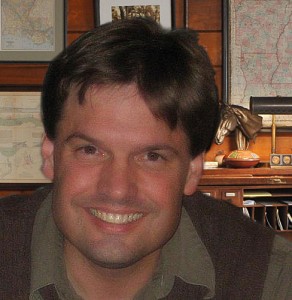
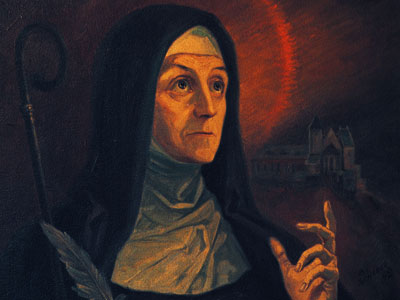
Benedictine Spirituality and Lectio Divina…a “way of being”. Â In part one of this particular teaching, Dr. Lilles discusses the life St. Hildegard of Bingen and her expression of Benedictine teaching.
To obtain a copy of Dr. Lilles’ book click here
Dr.Anthony Lilles is a Catholic husband and father of three teaching Spiritual Theology at St. John Vianney Theological Seminary. He  teaches spiritual theology and spiritual direction to transitional deacons, and the spiritual classics to the men who enter the Spirituality Year, a year of prayer in preparation for seminary formation.  He is the author of the “Beginning to Pray”  Catholic blog spot.
For other episodes in the series visit the Discerning Hearts page for Dr. Anthony Lilles
Tags: Anthony Lilles, catholic, catholic podcast, catholic prayer, cathollc spirituality, Discerning Hearts, prayer, Spirituality Year, st. hildegard
This entry was posted on Wednesday, August 28th, 2013 at 9:43 pm
You can follow any responses to this entry through the RSS 2.0 feed.
Episode 4 -Listening For Truth– Encountering fear in prayer.  The necessity for spiritual direction!  Purification as part of the process for spiritual growth.  The virtue of Obedience.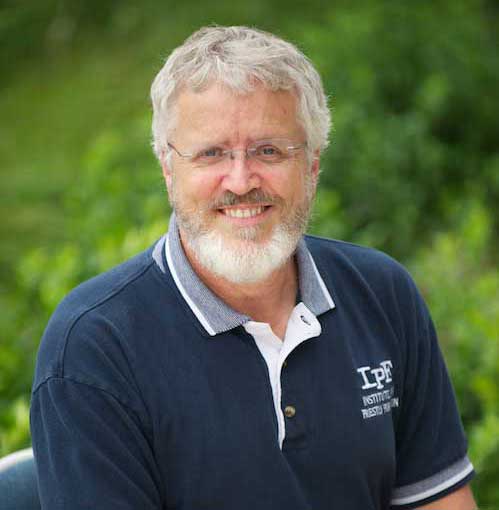
[powerpress]
Deacon James Keating, PhD, the director of Theological Formation for the Institute for Priestly Formation, located at Creighton University, in Omaha, is making available to â€Discerning Hearts†and all who listen, his series of programs entitled “Listening For Truthâ€.
 Listening for Truth leads men and women in a search for a fuller experience of God that begins in prayer, grows in the rediscovery of our spiritual being, and grounds itself in the truth of Jesus Christ. A presentation of the Christian life as an engagement of the whole person — body, mind, and soul — in the challenge of daily living.

For more information on the “Institute of Priestly Formation†and for other material available by Deacon Keating, just click here
Don’t forget to pickup a copy of “Communion with Christ†, it is one of the best audio sets on prayer…ever!
Check out Deacon Keating’s “Discerning Heart†page
Tags: creighton university, Deacon James Keating, Deacon Keating, prayer
This entry was posted on Tuesday, August 13th, 2013 at 5:54 pm
You can follow any responses to this entry through the RSS 2.0 feed.
Show 43 ” Building a Kingdom of Love” –  Are You A Faithful Servant?
[powerpress]
Msgr. Esseff reflects on the teaching of Jesus:
Gospel
LK 12:35-40
Jesus said to his disciples:
“Gird your loins and light your lamps
and be like servants who await their master’s return from a wedding,
ready to open immediately when he comes and knocks.
Blessed are those servants
whom the master finds vigilant on his arrival.
Amen, I say to you, he will gird himself,
have the servants recline at table, and proceed to wait on them.
And should he come in the second or third watch
and find them prepared in this way,
blessed are those servants.
Be sure of this:
if the master of the house had known the hour
when the thief was coming,
he would not have let his house be broken into.
You also must be prepared, for at an hour you do not expect,
the Son of Man will come.â€
Msgr. John A. Esseff is a Roman Catholic priest in the Diocese of Scranton. He was ordained on May 30th 1953, by the late Bishop William J. Hafey, D.D. at St. Peter’s Cathedral in Scranton, PA. Msgr. Esseff served a retreat director and confessor to Blessed Mother Teresa.   He continues to offer direction and retreats for the sisters of the missionaries of charity around the world. Msgr. Esseff encountered St.  Padre Pio,  who would become a spiritual father to him. He has lived in areas around the world,  serving  in the Pontifical missions, a Catholic organization established by Bl. Pope John Paul II to bring the Good News to the world especially to the poor. Msgr. Esseff assisted the founders of the Institute for Priestly Formation and continues to serve as a spiritual director for the Institute. He continues to  serve as a retreat leader and director to bishops, priests and sisters and seminarians and other religious leaders around the world. Â
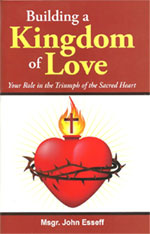
To obtain a copy of Msgr. Esseff’s book byvisiting here
Be sure to visit Msgr. Esseff’s website “Building a Kingdom of  Love”
Tags: Good News, LK, retreat, Roman Catholic
This entry was posted on Saturday, August 10th, 2013 at 4:47 pm
You can follow any responses to this entry through the RSS 2.0 feed.
Deacon James Keating, of the Institute for Priestly Formation, speaks about “The Role of Deacon” and St. Lawrence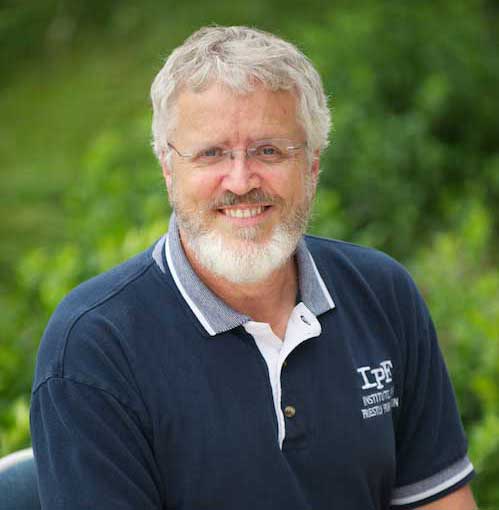
[powerpress]
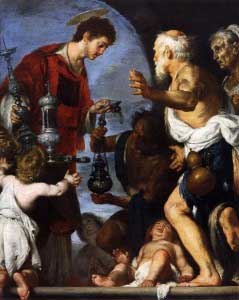 St. Lawrence of Rome was one of the seven deacons of ancient Rome who were martyred during the persecution of Valerian in 258.
His story is so touching (click here for a thorough telling). He models the charism of diakonia…genuine “ministry” of the gospel in the heart of the Church. He witnessed to and lived out the command of Our Lord as found in Matthew 25. Oh…to truly know modern day deacons in the order of Lawrence…
Often we see holy cards that depict Lawrence fully vested and holding what looks like a rack from a Weber kettle. But his martyrdom was actually horrific and deserving of deeper reflection. He could have avoided it, given the Roman official what he desired and spared his own life…but he didn’t. The grace he received to bear witness lives for the centuries as a tremendous testimony of faith speaking out in truth and love…no matter what. The image below is by Titian, and is the one I hold in my heart for St. Lawrence.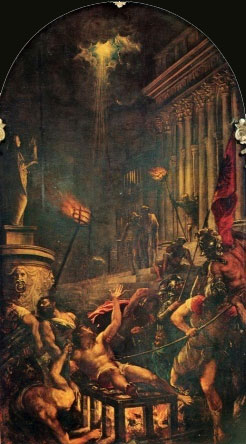
Tags: deacon, Deacon James Keating, deacons, heart, institute for priestly formation, martyrdom, rome, witness
This entry was posted on Saturday, August 10th, 2013 at 7:30 am
You can follow any responses to this entry through the RSS 2.0 feed.
Episode 2 – The Holy Rule of St. Benedict: A Spiritual Path for Today’s World with Fr. Mauritius Wilde O.S.B., PhD. Â In Place of Many Vain Words, Silence. There is a time for speaking and a time for silence. Â The secret of silence…it is the best way to listen to God.
[powerpress]
From the Holy Rule of St. Benedict:
CHAPTER VI
Of Silence
Let us do what the Prophet saith: “I said, I will take heed of my ways, that I sin not with my tongue: I have set a guard to my mouth, I was dumb, and was humbled, and kept silence even from good things” (Ps 38[39]:2-3). Here the prophet showeth that, if at times we ought to refrain from useful speech for the sake of silence, how much more ought we to abstain from evil words on account of the punishment due to sin.
Therefore, because of the importance of silence, let permission to speak be seldom given to perfect disciples even for good and holy and edifying discourse, for it is written: “In much talk thou shalt not escape sin” (Prov 10:19). And elsewhere: “Death and life are in the power of the tongue” (Prov 18:21). For it belongeth to the master to speak and to teach; it becometh the disciple to be silent and to listen. If, therefore, anything must be asked of the Superior, let it be asked with all humility and respectful submission. But coarse jests, and idle words or speech provoking laughter, we condemn everywhere to eternal exclusion; and for such speech we do not permit the disciple to open his lips.
Father Mauritius Wilde, OSB, Ph.D., did his philosophical, theological and doctoral studies in Europe. He is the author of several books and directs retreats regularly. He serves as Prior of our monastery in Schuyler.
For more information about the ministry of the the Missionary Benedictines of Christ the King Priory in Schuyler, Nebraska visit here:
Tags: Holy Rule of St. Benedict, Mauritius
This entry was posted on Friday, August 9th, 2013 at 2:18 am
You can follow any responses to this entry through the RSS 2.0 feed.
 Episode 12 – Great Works in Western Literature with Joseph Pearce – Mark Twain
[powerpress]
Mark Twain’s Adventures of Huckleberry Finn is, according to many critics and fond readers, the great American novel. Full of vibrant American characters, intriguing regional dialects and folkways, and down-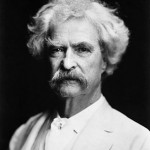 home good humor, it also hits Americans in one of their greatest and on-going sore spots: the fraught issue of racism.
As Huck and Jim float down the Mississippi and encounter all manner of people and situations, and as Huck struggles mightily with his conscience concerning Jim, the novel strongly invites a moral and religious perspective.
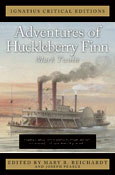 Based on the Ignatius Critical Edition, this series examines, from the Judeo-Christian perspective, the life, the times, and influence of authors of great works in literature .
Joseph Pearce is currently the Writer-in-Residence and Visiting Fellow at Thomas More College of Liberal Arts in Merrimack, New Hampshire. He is also Visiting Scholar at Mount Royal Academy in Sunapee, New Hampshire. He is also Visiting Scholar at Mount Royal Academy in Sunapee, New Hampshire. He is  co-editor of the Saint Austin Review (or StAR), an international review of Christian culture, literature, and ideas published in England (Family Publications) and the United States (Sapientia Press). He is also the author of many books, including literary biographies of Solzhenitsyn, J. R. R. Tolkien, C. S. Lewis, G. K. Chesterton, and Oscar Wilde.
To learn more about the authors and titles available in the Ignatius Critical Editions
Tags: ave maria university, conscience, humor, ignatius press, joseph pearce, Mark Twain, New Hampshire, oscar wilde, sapientia press
This entry was posted on Friday, August 9th, 2013 at 1:08 am
You can follow any responses to this entry through the RSS 2.0 feed.